
Eleven years ago, when I was still in the early days of pursuing wildlife photography as a serious hobby, I travelled to Lauvsnes in Flatanger, Norway. This was where Ole Martin Dahle had turned his deep passion and dedication to white-tailed eagles into a unique business. For more than twenty years, he has taken wildlife photographers from all over the world out onto the fjords, offering them the opportunity to get remarkably close to these magnificent birds as they dive into the water to catch fish.
Now, at the age of 68, Ole Martin has decided to retire and I simply could not miss the opportunity to return to Flatanger for one final, and hopefully unforgettable, experience with the legendary “Eagle Man”.
Travelling to Flatanger
It is not particularly straightforward to reach Lauvsnes in Flatanger by plane from Denmark, so my wife and I decided to make the journey by car. Although it meant driving around 1,200 kilometres each way, it was great to be able to bring all my photography equipment without having to worry about airline weight restrictions. And, of course, travelling by car gave us the opportunity to enjoy the beautiful Norwegian landscape, particularly the spectacular scenery on the journey from Oslo to Flatanger.
The guesthouse in Lauvsnes
On the afternoon of Sunday, 6 September 2026, we arrived at the lovely guesthouse in Lauvsnes, where we would spend the next four days in the company of the Swedish wildlife photographer Brutus Östling and three other Swedish participants.
The “Eagle House” is a comfortable and well-equipped house overlooking the fjord. It has everything needed for self-catering, although there is also a restaurant, Zanzibar, in the village. We decided to have a warm meal at the restaurant each day, while preparing our own breakfast and lunch at the house.
The original plan was to have a morning and an evening session on the fjord on each of the following three days. However, with the weather forecast for Monday looking rather poor, it was decided to make the most of the Sunday afternoon and head out onto the fjord for our first session already that evening.
First encounter with the eagles
In the late afternoon, the weather looked promising, with some sunny spells and only light winds. But as soon as we left the house to make the short drive down to the harbour, it started to rain.
Wearing a flotation suit, the light rain was not a problem, and I was using rain cover on my camera and lens anyway to protect them from the saltwater spray.
The village and Lauvsnes harbour
Down at the harbour, Ole Martin warmly welcomed us aboard his small, specially built aluminium boat. He had brought plenty of large fish to attract the white-tailed eagles. Saithe is used most of the time, although mackerel is also on the menu when it is in season.
Once out on the fjord, the surroundings were spectacular. We sailed between the small islands and beneath the impressive cliffs where the eagles spend much of their time. And from the very moment we left the harbour, we were surrounded by seagulls.
They probably play an important role in attracting the white-tailed eagles. The eagles recognize Ole Martin’s boat and know that fish may soon be on offer. And for the gulls themselves, there is an equally tempting incentive: plenty of nutritionally complete Frolic dog food!
It didn’t take long before the first white-tailed eagle appeared. Approaching the boat high in the sky, it was time to get ready for our first images.
Ole Martin took out a fish and held it high in the air, letting the eagle know that feeding time had begun. He then threw the fish into the water to the left of the boat, giving us a good idea of where the eagle would make its approach.
Suddenly, the eagle started preparing for its dive. Despite its impressive size, it can be surprisingly demanding to track as it comes in at considerable speed. You have only a few seconds to pick it up in the viewfinder and keep it within the frame as it heads towards the fish.
A white-tailed eagle has just grabbed a fish only 19 meters from the boat.
I was using my Canon R5 Mark II with the EF 300mm f/2.8L IS II USM, and it turned out to be an excellent combination. The eagles can often get as close as 20 metres from the boat when catching a fish, so there is little need for an extremely long focal length. The 300mm also lets in plenty of light, allowing me to use fast shutter speeds, while I particularly like the beautiful background blur when shooting wide open at f/2.8.
Of course, shooting at f/2.8 also means a relatively shallow depth of field, which affects how much of the eagle is rendered sharply. However, despite being such a large bird, this is not really a problem if the eagle is broadside to the camera. At a distance of around 20 metres, the total depth of field is approximately 74 centimetres, with about 36 centimetres in front of the focus point – the eagle’s eye – and 38 centimetres behind it.
The only downside to this camera and lens combination is the weight. Including the battery grip, I have to handhold around 4 kg of equipment. That is fine for short periods, but when you need to remain ready for an extended time, it becomes increasingly difficult to manage. And in a small boat, the challenge is made even greater when the waves cause the boat to move beneath you.
We had several dives, and although I missed a few opportunities, I still managed to capture some great images of the white-tailed eagles catching fish.
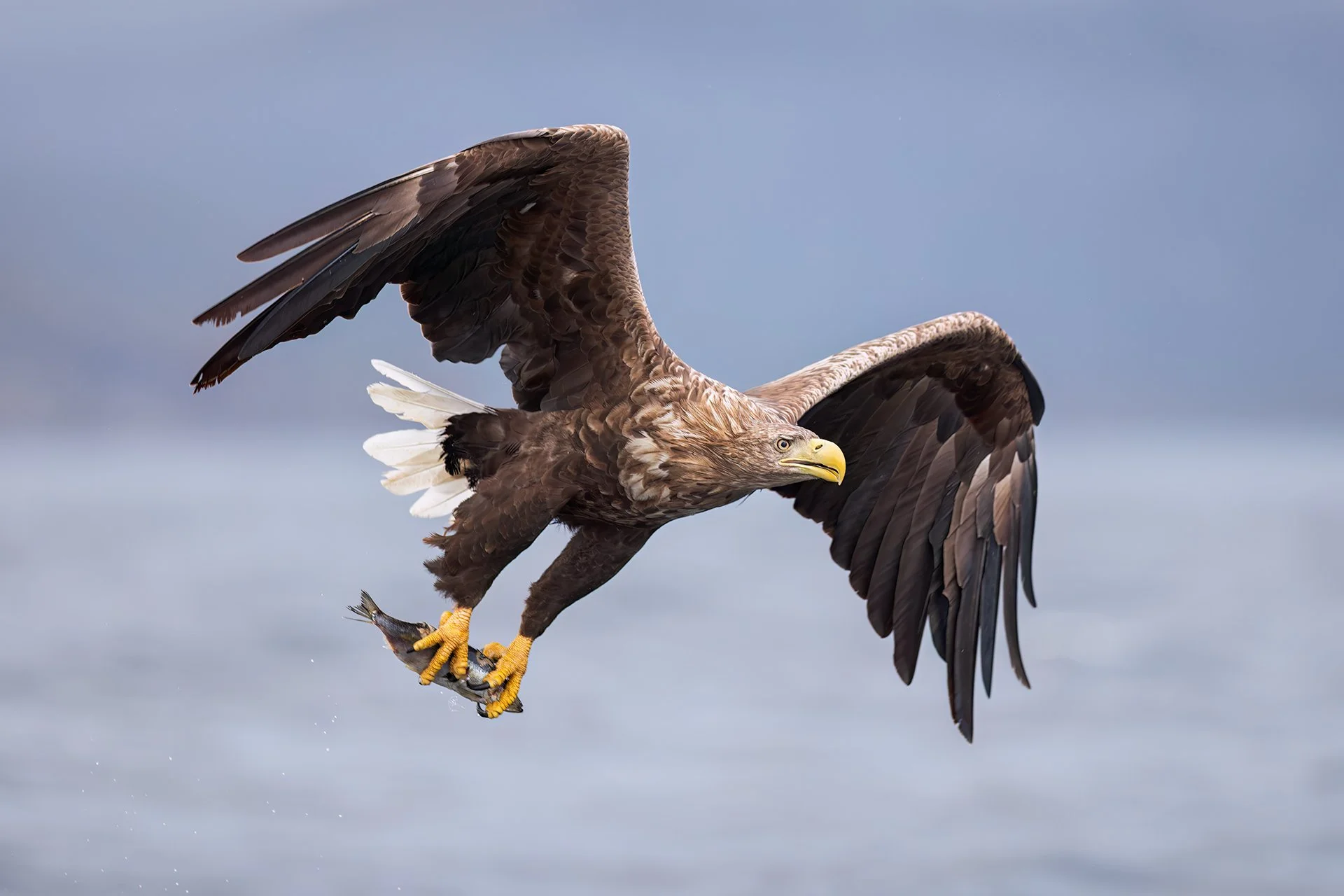
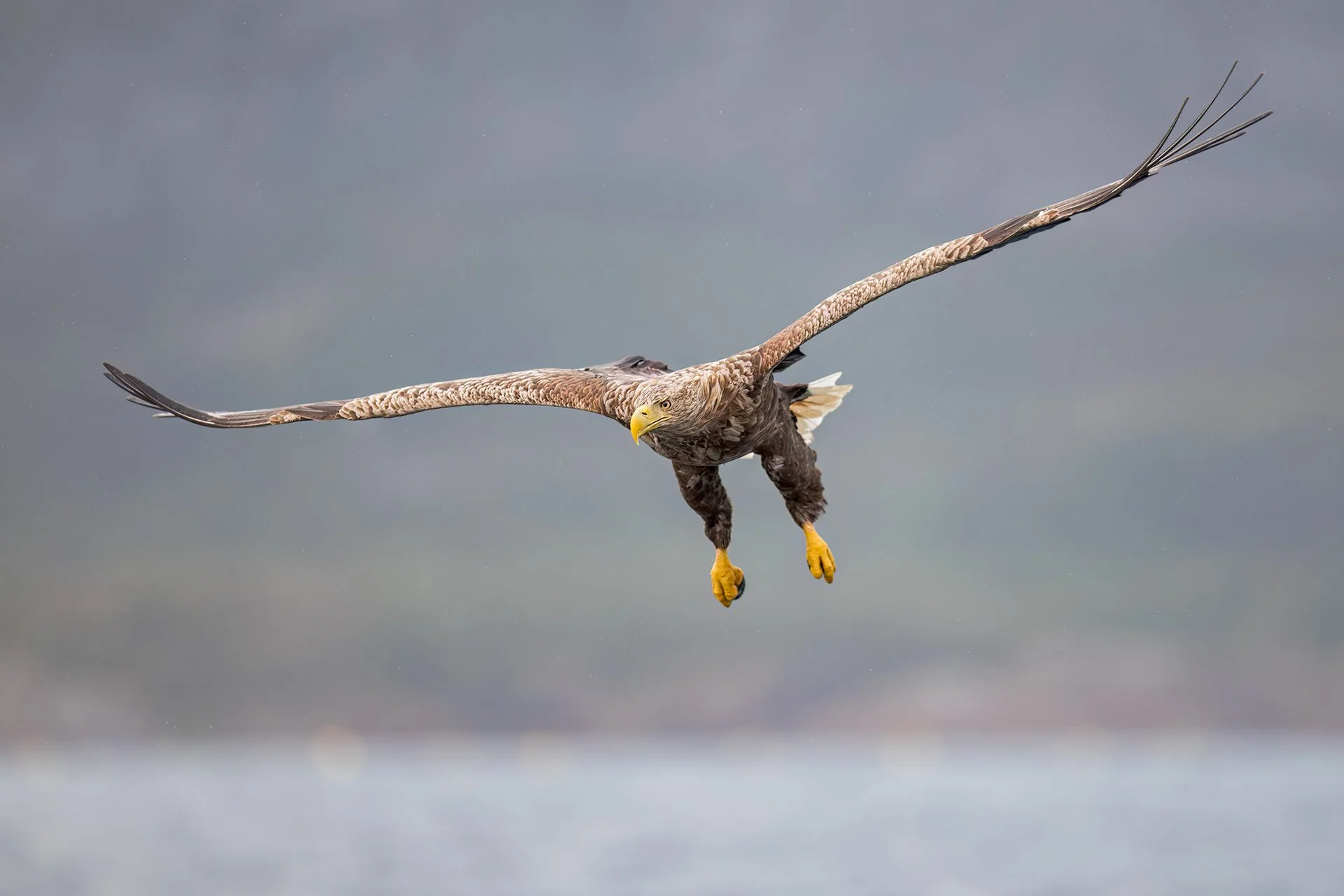
After about an hour, the weather changed dramatically. Suddenly, the rain was pouring down and the wind began to pick up. I was certainly glad that we had decided to go out on Sunday evening, especially with the forecast suggesting that Monday could bring bad weather … ; - )
It was tough being out on the fjord in those conditions, trying to photograph the eagles. Yet, the challenging weather also created some extraordinary photographic opportunities – and ultimately, that is what it is all about. Had we known beforehand just how severe the conditions would become, we probably would never have ventured out that evening.
Extreme weather on the fjord but the eagles still came down for fish.
Later, back at the guesthouse, we all agreed that it had been an incredible evening. Looking through my images, I realised that I had captured some of my favourite photographs of the entire trip. Not many wildlife photographers get the opportunity to photograph white-tailed eagles catching fish in such dramatic conditions.
Forest hide and afternoon on the fjord
The Monday morning session was cancelled as we had already had an extraordinary outing on Sunday evening. Instead, we were treated to a few hours in Ole Martin Dahle’s forest hide.
Brutus Östling laying out seeds in front of the hide.
Only a short drive from the guesthouse, the “Eagle Man” has a newly built hide in the forest. It can accommodate four photographers at a time, and a reflection pool in front of the hide adds another dimension to the images.
A variety of small birds came to the feeding area, including European Greenfinches, Eurasian Nuthatches and Coal Tits. However, they were difficult to photograph as they usually stayed for only a split second before grabbing a seed and disappearing again.
A Eurasian Jay was much easier, often sitting in front of the hide for a longer period at a time.
But the main attraction for me was a Red Squirrel that occasionally came by. It was incredibly cute and photogenic, and in my eyes, it was a huge advantage over the small birds.
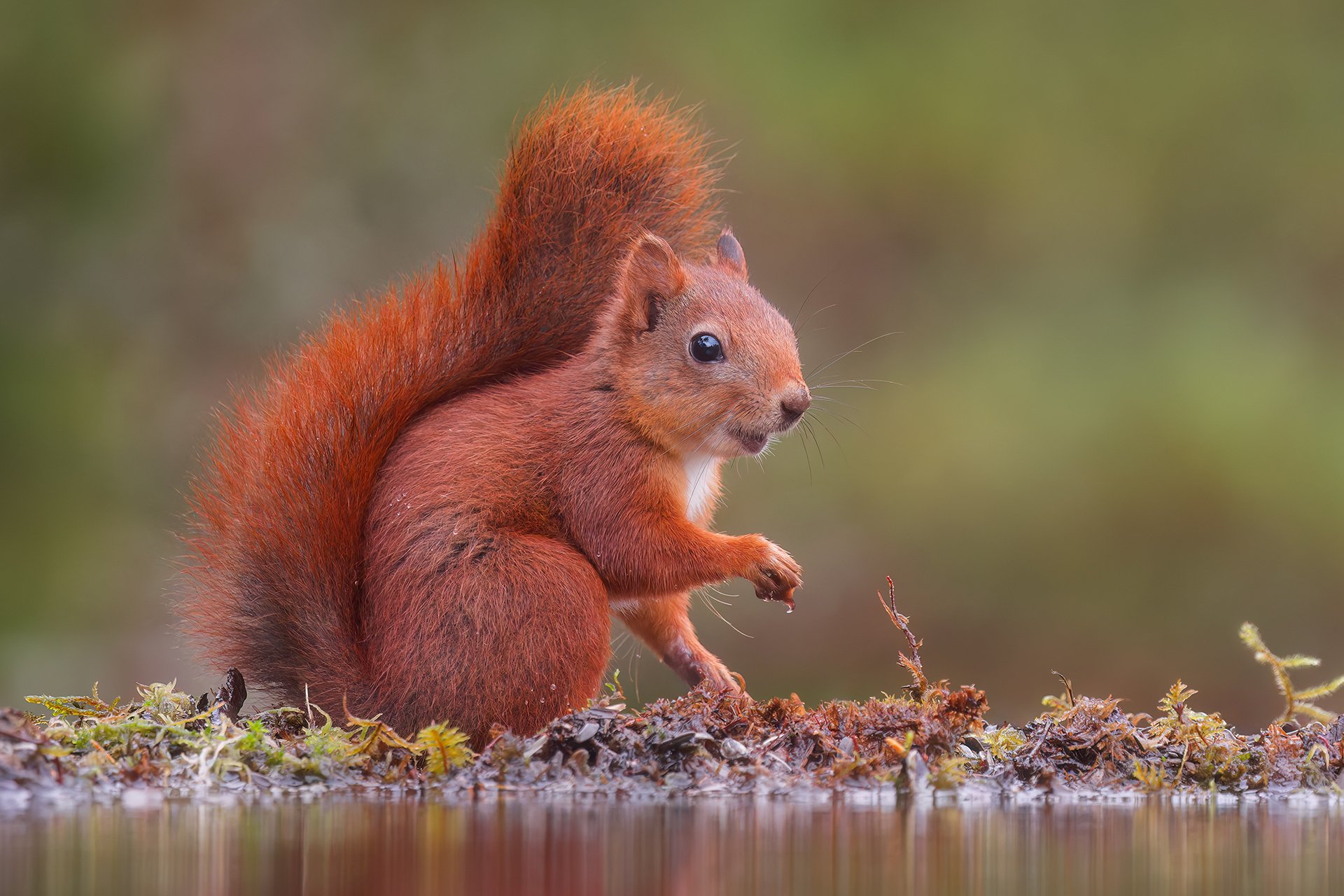
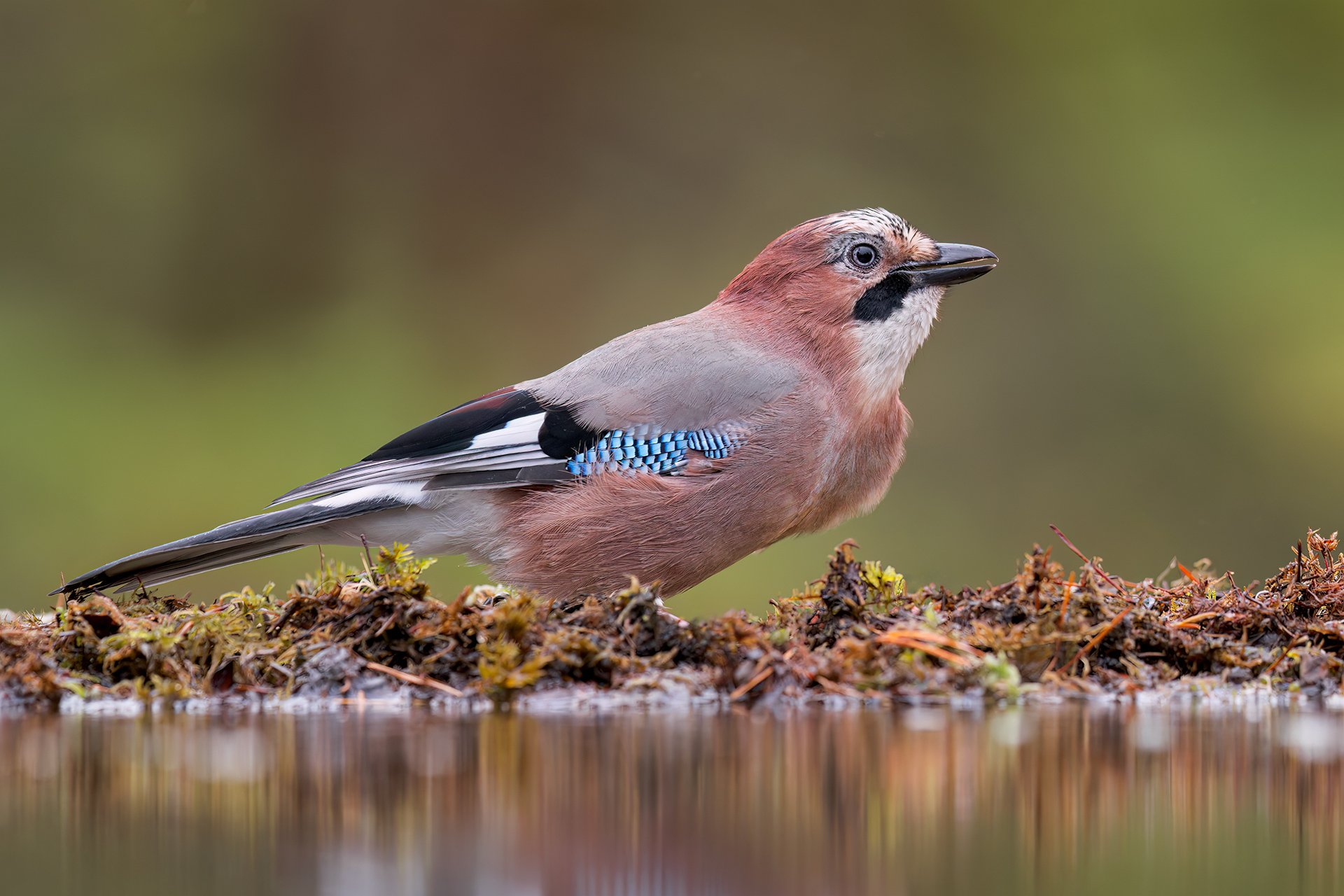
Fortunately, the weather turned out to be much better than forecast on Sunday, and later in the afternoon we were able to head out onto the fjord once again to photograph the white-tailed eagles.
Still overcast conditions on the fjord photographing white-tailed eagles.
Despite the overcast conditions and some light rain, we had a great couple of hours with the eagles, including a session with Miguel, probably the most famous white-tailed eagle in Norway.
At around 37 years old, Miguel is one of the oldest known white-tailed eagles in the country. He holds a territory on the mountainside near the harbour, and when Ole Martin is out on the fjord, he usually pays Miguel a visit and brings him a fish.
The world famous 37 year old white-tailed eagle Miguel.
It didn’t take long for Miguel to come down and take the fish before carrying it back up onto the hillside to feed. As we slowly approached to get some photographs, however, he suddenly decided to take off. That moment gave me the opportunity to capture an image with some beautiful vegetation in the background.
Another day on the fjord
The weather forecast for Tuesday was looking promising, but in this part of the country you never really know what to expect.
We left the guesthouse shortly before seven in the morning, and the weather was fine and dry.
On the morning sessions, Ole Martin sails north rather than south, as he does on the afternoon and evening trips. Here, the cliffs are higher, providing different backgrounds with more vegetation and a very different setting for photographing the eagles.
In the morning we sail north with more vegetation covered cliffs as background.
Despite several dives during the two-hour trip, the photographic results were rather disappointing. Whether it was down to my skills or the eagles’ poor understanding of composition is still open to debate.
Nevertheless, it was nice to return to the guesthouse completely dry for the first time. We had several hours to relax before heading out again at six in the evening, after enjoying a hot meal at the Zanzibar Inn in the afternoon.
Around noon, it started to rain heavily, but by the time we drove to the harbour for the evening session, the weather had cleared up nicely.
My wife and I arrived in good time, ahead of the rest of the group, and took the opportunity to capture a memorable image of her with the “Eagle Man” in his boat – probably the image of the trip!
My wife Nete and the Eagle Man on the boat.
It turned out to be a couple of hours with an extraordinary number of eagles and a crazy number of gulls.
With the sun shining, we decided to go for some backlit images. However, as the sun was still fairly high in the sky, the conditions were far from ideal for this kind of photography over open water.
At one point, I managed to capture an eagle flying backlit against a cliffside after catching a fish. By deliberately underexposing the image, I was able to create a decent shot with a black background.
White-tailed eagle backlit against the dark cliffside.
Despite the many eagles that evening, I returned with only a few keepers. Fortunately, the weather was beautiful, and simply being out in such a stunning environment made me happy. And, of course, we still had two more sessions to look forward to.
One of the few keepers from the evening session.
Final day with the Eagle Man
According to the weather forecast, it was supposed to rain during the night and stay dry throughout the day – and fortunately, the prediction proved correct!
Our session started at eight o’clock in the morning. There was no reason to head out any earlier for sunrise, as the high mountains surrounding the fjord block the rising sun.
We had a great morning on the fjord, with several white-tailed eagles diving for fish. While most of the previous days had been overcast, it was wonderful to finally see some sunshine, bringing out beautiful blue hues in the water.
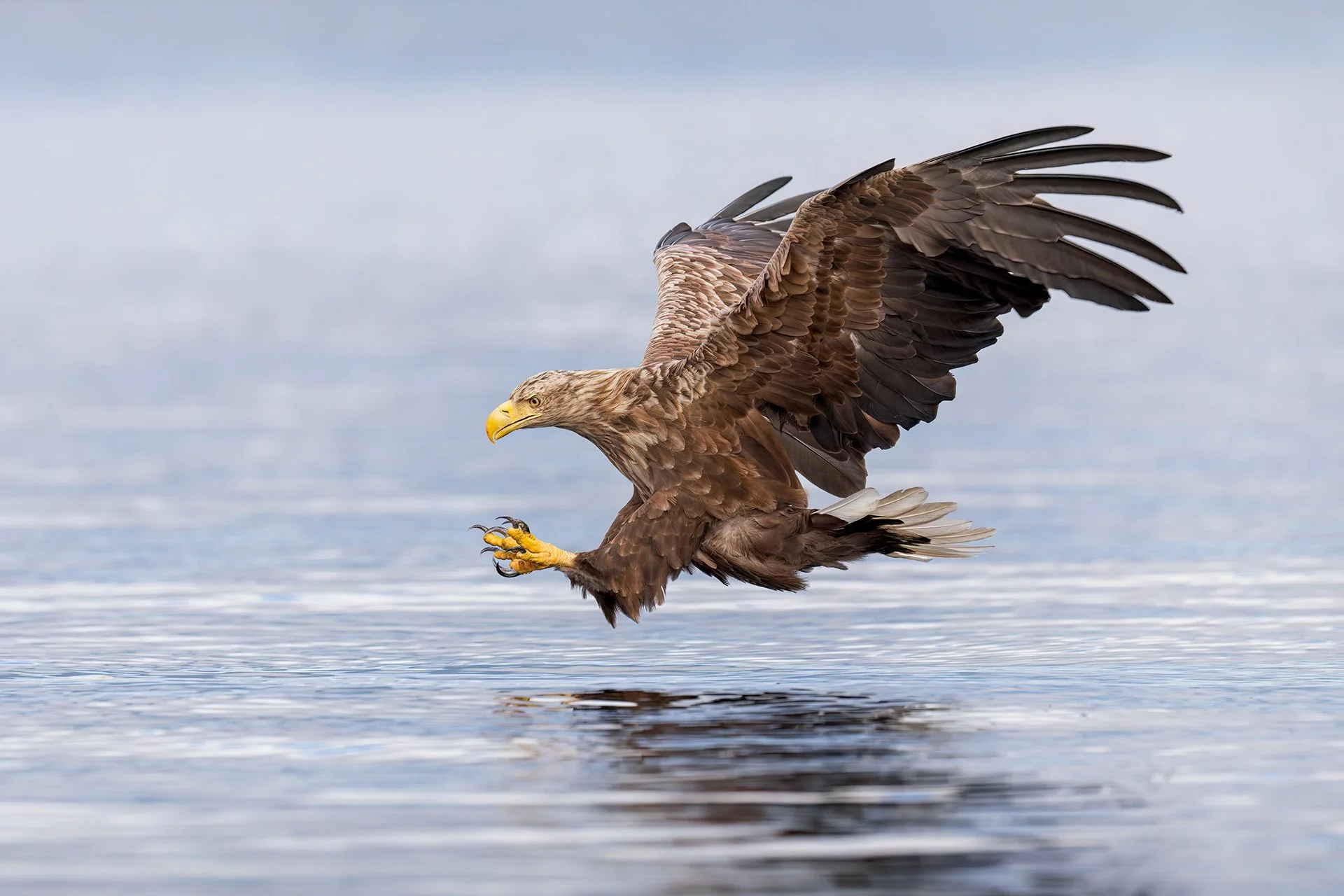
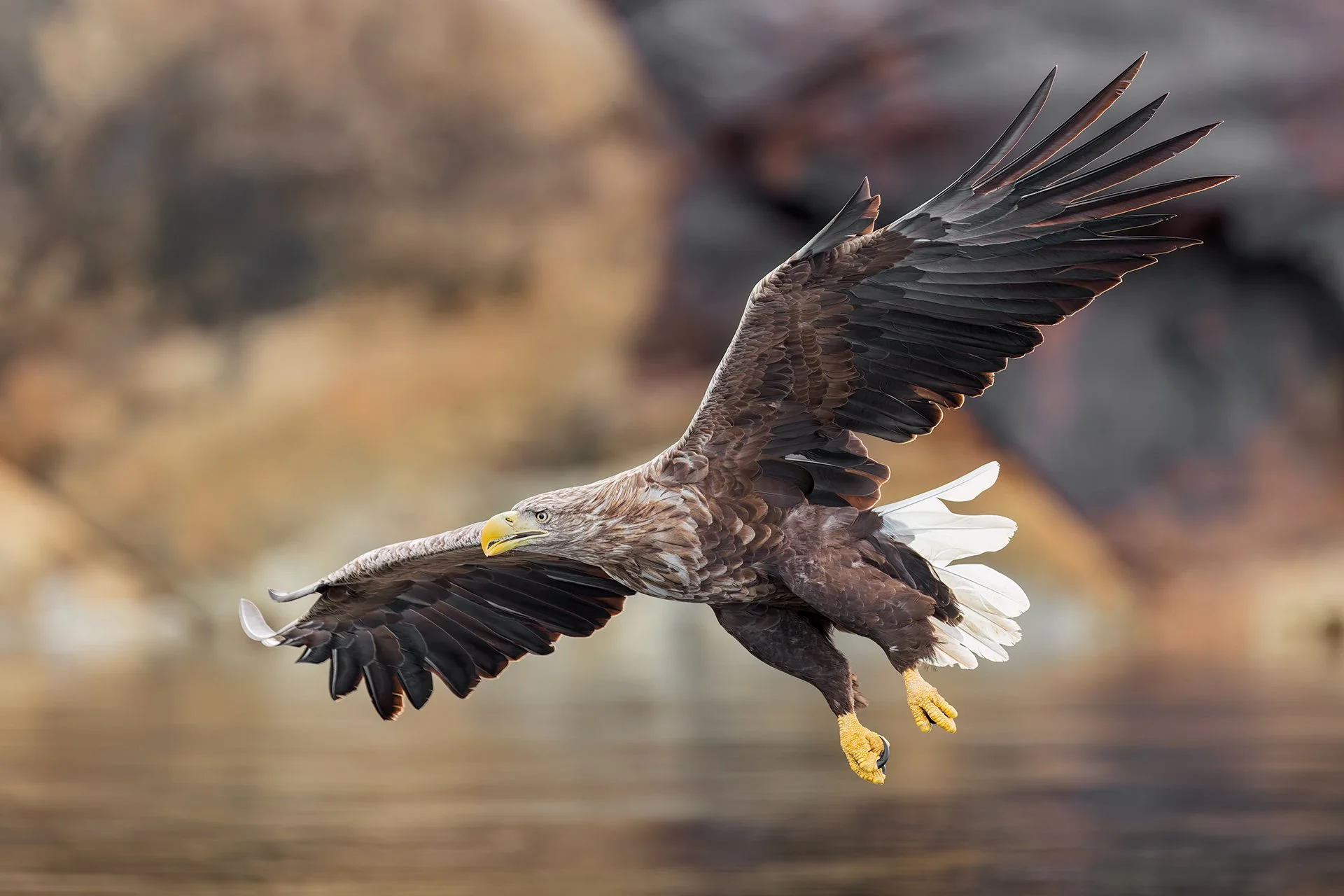
After four previous sessions, we had become quite experienced at photographing the eagles. Despite being such a large bird, a white-tailed eagle moves remarkably fast when diving for a fish. The decisive moment is over in an instant, and your ability to track and focus on the eagle as it approaches the water is really put to the test.
With a wingspan of up to 250 cm, it is easy to cut off part of the wings, and the composition does not always turn out as you had hoped.
One particular thing I noticed was that when panning to track an eagle as it caught a fish, I often ended up with the bird too far to the right in the frame at the moment it grabbed the fish. Instinctively, I would continue panning at the same speed throughout the dive, without taking into account that the eagle suddenly slows down as it reaches the water and grabs its prey.
I had already noticed this when reviewing my images after the first day, but it was still surprisingly difficult to convince my brain to slow down the panning movement at exactly the right moment.
Of course, there is more to a successful image than simply keeping the eagle in the frame. You also need a good background and, ideally, the eagle approaching the fish from the right direction. This is where Ole Martin Dahle’s many years of experience play an important role. He always makes sure that we photograph from the left side of the boat and positions the boat and the fish to give us the best possible angle.
This seagull just got some Frolic dog food.
White-tailed eagles are heavy birds, and they use a headwind to help control their descent and approach to the prey. Ole Martin always takes this into account before throwing a fish into the water, giving the photographers the best possible conditions.
During our six outings on the fjord, the wind was calm most of the time, making it difficult to predict which direction an eagle would approach from and to position the boat accordingly.
On our first day, when the wind was strong, we therefore had the best opportunities to photograph eagles flying directly towards us.
This morning, I also spent some time photographing the gulls with a wide-angle lens. They come remarkably close to the boat and are even fed by hand. I took lots of fun images at a focal length of 16mm, with gulls sometimes less than 50 cm from my face.
The seagulls comes very close to you on the boat.
Towards the end of the morning trip, we sailed into the completely calm, dark water beneath the cliffs near the harbour. Here, it is possible to create some interesting images of gulls on the water by exposing for the bright white birds and deliberately underexposing the scene, turning the surrounding water almost completely black.
You can get some dramatic images when the water is in shadow.
As this is also the home territory of the famous Miguel, I hoped to capture a backlit image of him catching a fish in the dark water. Before travelling to Flatanger, I had seen many images of this kind, with an almost completely black background and only the eagle and the splash of water revealing the action.
To achieve this dark, dramatic effect, the sun needs to be shining so that the scene can be deliberately underexposed. The eagle also needs to dive at just the right angle. Most importantly, the surface of the water has to be completely calm, as even small disturbances can create unwanted bright areas.
Not all the pieces fell into place. A large number of gulls had just disturbed the surface of the water, and Miguel did not fly exactly parallel to the boat. Nevertheless, I managed to get a decent image with the dark, dramatic expression I had hoped to capture.
At least I got this image of Miguel backlit in the dark.
Now it was time to relax for a few hours before heading out for one final farewell to the Eagle Man and his white-tailed eagles.
The weather was still fine, with sunny spells, hardly any wind and a temperature of 12 degrees Celsius when we boarded the small boat again in the late afternoon.
As always, the eagles came for their fish, and we had a few dives before heading farther out into more open water. It was the first time we had ventured beyond the inner fjord, and despite there being hardly any wind, the waves were surprisingly high.
A young white-tailed eagle with a catch on our last evening on the fjord.
For me, this made photography extremely challenging. Handholding the heavy camera and lens while the boat was moving up and down in the waves made it almost impossible to keep the eagles in the frame as they came down to catch a fish.
We soon returned to calmer water, hoping for a beautiful sunset to finish off the adventure. Unfortunately, clouds began to build, and we missed the opportunity to photograph silhouettes of white-tailed eagles against the setting sun.
Unfortunately, it got cloudy before sunset.
Nevertheless, it had been another wonderful day on the fjord and a fitting end to our time in Flatanger. Back at the harbour, we said a warm farewell to the Eagle Man after six memorable outings with him and his white-tailed eagles.
All that remained was to get a good night’s sleep before beginning the two-day drive back home to Denmark.
Closing remarks
One of the first things I did after returning from my first trip to Flatanger in 2015 was to buy a flotation suit. Although we could borrow one from the guesthouse free of charge, I liked the idea of having my own, as I fully expected to return to the Eagle Man many times in the years ahead.
Looking back, I cannot quite understand why it took me eleven years to return to this stunningly beautiful place and to the great personality of the legendary Eagle Man – not to mention the unforgettable encounters with the white-tailed eagles and the extraordinary photographic opportunities they provide.
Thankfully, I made it back for this final trip before Ole Martin retires, and I am especially happy that my wife came along so we could share the adventure together.
I had high expectations of returning home with better images this second time around. I am a much more experienced wildlife photographer today, and my equipment has improved dramatically since my first visit. I was certainly not disappointed.
The Eagle Man .
Many great images have been added to my portfolio, and even my wife returned home with photographs to be proud of, despite only recently taking up wildlife photography herself.
But in the end, the photographs were not the most important part of the journey. What mattered most was the opportunity to experience this magnificent place once again.
Being out on the fjord in a small boat, surrounded by the beautiful coastal scenery, weaving between countless islets and watching these immense eagles in their natural environment is an experience worth making the journey for. Coming home with great images is almost just a bonus.
This will be Ole Martin Dahle’s final active year as a guide, but I am sure he will still venture out onto the fjord from time to time to visit his feathered friends.
After more than twenty years of giving wildlife photographers from around the world unforgettable encounters with the white-tailed eagles of Flatanger, he has certainly earned his retirement.
Wishing the Eagle Man a long and wonderful retirement – and thank you for the memories!
